The Journey Begins

As a college student money is tight most of the time, and with a down turn in the economy it has become even more important to curb my spending. People always talk about college students' spring break trips and the crazy amount of money spent on excursions to all the corners of the globe. Unfortunately, I am not able to afford these pricy vacations and I began to think about what I could do to experience culture in my own backyard. As I researched my community and university, I came upon the University Museums website and learned just how important they really are. The most impressive thing about the museums on campus is their collection of public artwork. Iowa State University has the largest collection of public works of art of any university in the United States! This fact shocked me and truly made me think... why do I have to take an airplane to see great art? Do I really need to spend a fortune to experience fine art and culture? The answer I came to was absolutely not! Not until I came to this realization did I feel I had something worthy of blogging about. This blog is my journey through 645 pieces of public work on the Iowa State University campus. I will include my opinions, my interpretations, and always a little background research to put the piece in context. Shall we go on a campus tour?


Monday, October 28, 2013

Terrazzo Floor, Julie Chang Curtiss Hall


                Earlier this month the new additions to Curtiss Hall were unveiled to the public. Curtiss Hall is home to the Agricultural College, as well as the Anthropology department, sneakily hidden away in the third floor. Having had an anthropology class daily in Curtiss throughout my 3 years here, I’ve been able to see the progress of this huge project.  We are lucky to have a newly renovated building with new classrooms, as well as the Global Café with plenty of seating and food available for students. Along with these new features, there are some additions to the art on campus collection.
                In my time as an intern with the museums, I’ve learned a lot about how much art Iowa State really has to offer on campus. We have the largest public art collection in the country, which I had no idea about until recently. Once you realize how much art we really have, you start noticing it everywhere. One of the great things about Iowa State’s public art is that every building has art that is applicable to the subject that is important in that building.
                Of the two new art pieces in Curtiss Hall, I’m going to be looking at the terrazzo floor by Julie Chang in first floor. Right in the center of the floor, this piece lines up with the overlook connecting all the floors of the building together, meaning you can see this piece from any floor you are on. I like how the terrazzo flowers and geometric shapes fit together with the material for the surrounding floor. In a lot of ways Iowa State’s Art on Campus is seen without being too obvious, like the other new glass piece lining the upstairs of the Global Café. The floor is something students will be walking over daily, and hopefully as they walk over the piece they see a new aspect of Iowa agriculture each time.
               

Looking over the new piece, I started looking from the floor above in order to get a complete view. The first thing I noticed is that it’s definitely not an obvious connection to agriculture and its many parts, but as you look at the individual pieces you start to fit everything together. The blue circling arrow was a prominent shape in the piece, it made me start thinking about the Lion King and the whole Circle of Life song. The blue arrow is connecting all of the other pieces of this giant floor puzzle together, and wherever the arrow touches another shape, there is this great layering of colors that make the piece so intricate. There is a mixture of geometric and natural shapes, and a mix of abstract and literal representations of Iowa agriculture. I see images of windmills, which are such a common sight on the Iowa skyline. The flowers and leaves show some of the blending of the colors, while incorporating images of what looks to be soybeans, one of Iowa’s main crops. Animal life is also represented in the floor, with metal inlays of insects and deer tracks.
                Many of the shapes are simplified versions of images that are very familiar to agriculture in Iowa. For those who are in the building actually studying agriculture, all they really need is a simple reminder to bring about thoughts of the plants and processes they’re studying. For the people just visiting, or maybe the anthropology major like myself, it gives us a little more freedom when looking at the floor. There’s a lot more room for imagination with a more abstract image. I love how this work of art is practical, and is hidden away in an everyday space. Combining every aspect of agriculture together in a simple abstract, I’m glad I’ll be walking over it everyday for the rest of my time here.

By Sydney Marshall

Thursday, September 12, 2013

"Untitled" Murals, Agronomy Hall, Richard Haas

Agronomy Hall- the site of my most stressful class freshman year.  I was an undecided, leaning towards history major from downtown St. Paul. The closest thing to any farm experience I had previously had was chasing after chickens on my Grandpa’s farm, but somehow I had gotten the idea into my head that Agronomy 114 would be a fun and easy class to take. Wrong. After my first hour in lecture I realized that I would be learning the basics of farming, instead of the plant genetics I had thought I signed up for. A few days later, I had to go to my lab to test my practical knowledge on the farming techniques I had never before heard of or even seen in real life.

 Unfamiliar with the building, I wandered around looking for my lab. I have stumbled across this mural many times, when I would foolishly try to take a different route to my class only to get swallowed up by the maze that is Agronomy Hall. The first mural is a scene from a false window, using the “Trompe l’oeil” style. This technique means to “trick the eye” in French. The artist mimics the wall’s surrounding tiles in the painting’s columns and floor, which are used to add depth. You can easily imagine yourself looking out across this beautiful landscape that is so familiar to Iowa. If you look closely, you can see the campanile, Marston water tower, and some of the other famous structures on campus. Someone once told me this mural was to remind the professors of the real goal of their research-the corn and the small farm seen in the foreground.

This mural was to me as a freshman an orientating piece. I was just getting to know the campus, and I was proud that I could look at this painting and be able to place where I was. Being new to Iowa, I was also quickly learning how much of an influence agriculture has on this state. I liked that there was a small farm in the painting; it seemed so calm there among all the crops and things that I was learning about in my class. The focus on everyday life and solving its problems was a good lesson for me and the professors who walk by this piece every day. They are working on solving our problems out in the field, while as a freshman I needed a small reminder to not get so wrapped up in the big problems in life.


I didn’t realize there was a second mural until much later. Having spent many hours in the lab asking the questions the equivalent of a 3 year old farm kid, I had somehow been hired as the new lab hourly. One day on an errand, I finally discovered the second painting. This mural fits my point of view as a junior at ISU just as much as the first did on my first day freshman year. I now have an overhead view of Iowa, no longer needing a guide to the small workings of everyday life. My eyes, like the view in the painting, are set on much bigger things. This mural has the same tricks of the eye as the first, making it appear as if you are looking out onto the whole of Iowa. Many of the geographical landscapes are shown- from the glacial plains to the Loess Hills. There is also a cyclone in the center of the painting. This is a reference to Iowa State of course, on the very edge of the storm. As a Junior, I feel as if I’m right in line with that cyclone- at the moment I’m out of those stormy skies of being new to Iowa State and to what my future will hold. Soon though I’ll be moving on to my adult life and career, and I’ll have to remember the first mural. Focusing on the everyday life and what your true goals are is sometimes the best way to get through the stormy times.

By Sydney Marshall

Friday, April 19, 2013

Central Campus


In light of VESHIEA I thought it would be fitting to write about Central Campus- the heart of ISU; 20 acres of land set aside for student use only.   I’m sure even with this rainy weather you have stopped by there at least once this week. During VESHIEA, Homecoming, Destination Iowa State and other social and club functions our Central Campus is used as a place to unify students from all different background, beliefs and majors. Even without organized gatherings on average how many times do you go through Central Campus?

A little bit of history for all of you out there Central Campus was set aside by our first president Adonijah Welch. Its design was planned from the positioning of the buildings to the types of trees and their placements.  Central Campus is like a temporary instillation; each day the campus is different and it’s up to you the student to take advantage of it.  The day can change so quickly, with the smile of a friend or the joy of students on a perfect day. On that perfect day get out there and lay around, meet new people and play a game of flag football.  Take advantage of this time, of  the life that we are in, the easy of meeting someone new and creating a new relationship.  Hope you guys get out there and enjoy Central Campus.  After all is that what life is about? Enjoying those little moments and making the most of them?

Happy VESHIEA week ISU! It’s a great day to be a cyclone!


Posted by Dorothee Nygren

Thursday, March 14, 2013

E+l+e+m+e+n+t+a+l

            Snow in March? What a weird concept to grasp coming from El Paso TX. You know in movies when there is always that one spot that the main character goes to clear their head; a roof top, a park, a coffee shop, that one desk in the corner of the library? I know that I have been searching for a place like that here on ISU’s campus.  With the way the weather has been lately it is hard trying to find it.  Where do we go when everything is covered in snow? Well students of ISU I think I may have found an answer.

            Located behind the Armory, Hach Hall has an open area that allows students to sit and eat, do homework, socialize with friends and enjoy the artwork around them. E+l+e+m+e+n+t+a+l by Norie Sato is a project that uses chemistry, elements and other aspects of scientific processes to inspire and create works of art.  These pieces are both playful and meaningful. The works are fun to look at and puts an interesting spin on chemical elements and the periodic table.

            I hope you will take a few friends maybe grab caribou on the way and go take a look at Sato’s work in Hach Hall.  It’s different, intriguing and could become your new spot to get away from everything.

By Dorothee Nygren

Wednesday, February 20, 2013

Cyclone Pride


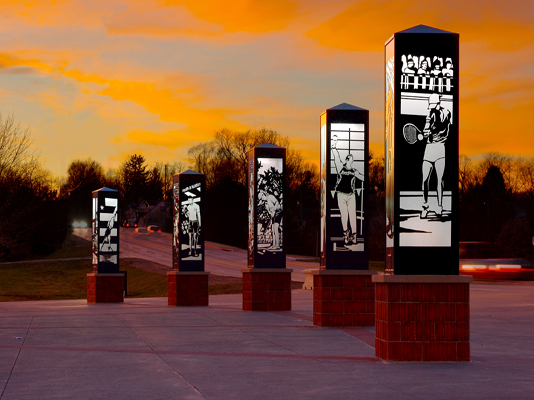
What better way to start off this blog than with some Iowa State Cyclone Pride?  Journeying through the art on campus I found that sometimes we can make connections to art in the most unlikely spaces. Intercollegiate Athletics: Founded in Education is a work of art that is passed by Iowa State students, alumni and friends in the Fall Semester on every game day.  Right in front of Jack Trice Stadium stands these five stationary lights that represent the tie between athletes and education.

Each pillar has four flat sides with different metal cutout images.  Three of the panels depict student athletes in action partaking in athletic activities, such as swimming, basketball, football, volleyball, and baseball.  The fourth panel shows a student performing an academic assignment, working in a lab, or playing an instrument.  The base of these light panels is molded terracotta made to look like shelves filled with academic books. 

After I had decided that I was going to write about this installation, a few of my friends and I drove past Jack Trice at night and saw the different impact it had.  At night, these panels were lit up from the inside, showing the athletes “glowing with knowledge.” Its funny how I never really noticed them before, but there they were.

Jack Trice Stadium is a monument for the students of Iowa State. It represents our Cyclone pride.  It’s only fitting that this work of art be placed where so many great athletes come to play.  So, next time you go to Jack Trice Stadium to support our Cyclones I hope you’ll take a look at these sculptures and when you do let me know what you think?

By Dorothee Nygren